

Sling Bag vs Crossbody Bag for Travel: Which One Should You Carry? (2026)
If you've searched "sling bag vs crossbody bag for travel" and found yourself more confused after reading the results — you're not alone. Most of the internet uses these terms interchangeably, which doesn't help when you're trying to make a real decision about what to carry on a trip.
There's a practical difference, and it matters for travel. This guide lays out what that difference actually is, how each style performs across real travel scenarios — airport security, European city streets, hiking trails, long transit days — and which one wins in each situation. By the end, you'll know exactly which bag style is right for your next trip.
The short version: A sling bag sits diagonally across the chest and swings to the front for access. A crossbody sits flat against the hip with a longer strap. Both work for travel — but they excel in different situations. The right choice depends on what you're carrying and how long you're carrying it.
Sling Bag vs Crossbody: Is There Actually a Difference?
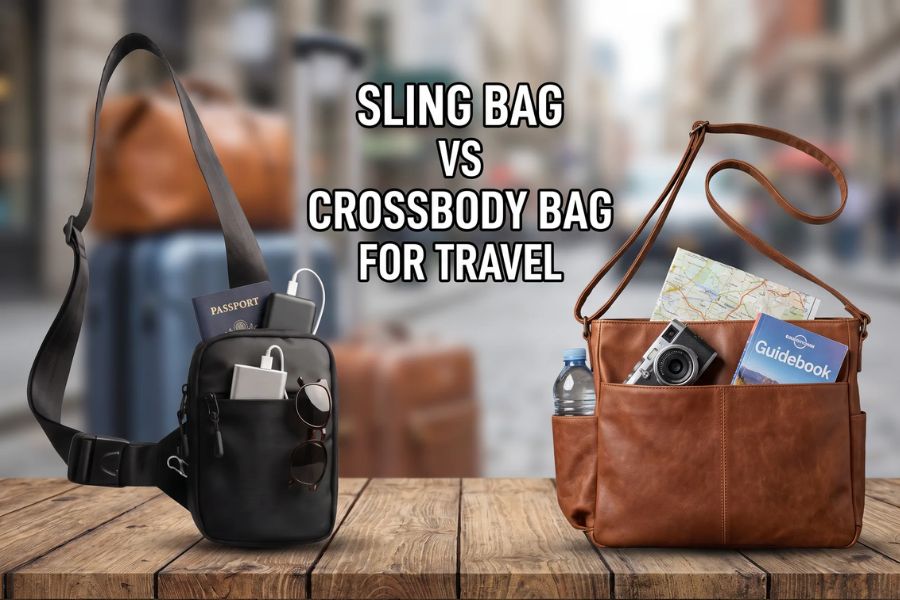
Yes — though the line has blurred as brands apply both labels to similar-looking bags. Here's the clearest way to think about it:
Sling Bag
- Single diagonal strap, worn across the chest or back
- Swings to your front for access without removing it
- Typically more structured; sits closer to the body
- Usually 5–15L capacity
- Strap anchors at both top and bottom of the bag
- Often has a chest clip for stability while moving
Crossbody Bag
- Single long strap, worn diagonally across the body
- Bag rests at hip or waist level on one side
- Often softer, flatter, more fashion-oriented silhouette
- Usually 3–8L capacity
- Strap attaches at two points on the bag's top edge
- More variation in style — from minimal to structured
In practice, the key functional difference for travel is where the bag rests and how you access it. A sling sits at chest level and rotates to your front — meaning you never lose sight of it in a crowd. A crossbody sits at your hip and opens from the side — faster for quick grabs, but less visible in crowded spaces.
Many modern travel sling bags are designed to function as both — long enough to wear crossbody-style at the hip, structured enough to rotate to the chest. That overlap is exactly why the terms get confused.
Head-to-Head Comparison for Travel
Let's put both styles through the specific demands of travel — not just casual daily carry.
| Category | Sling Bag | Crossbody Bag |
|---|---|---|
| Security in crowds | Advantage — rotates to chest, always in view | Hip position is harder to monitor in tight crowds |
| Comfort all-day | Advantage — diagonal strap distributes weight across torso | Hip/shoulder weight can cause fatigue on long days |
| Capacity | Advantage — typically holds more; structured shape | Usually slimmer; better for minimal carry only |
| Quick access | Slightly slower — rotate bag first | Advantage — hip position opens fast |
| Airport security | Advantage — one bag, off quickly, fits in tray | Similar ease; smaller bags clear faster |
| Fits under airline seat | Advantage — structured shape slides easily | Soft structure can bunch awkwardly |
| Style flexibility | Clean, minimal, sporty or urban look | Advantage — wider range from casual to dressy |
| Anti-theft features | Advantage — most anti-theft bags are sling style | Fewer options with built-in security features |
| Laptop or tablet carry | Advantage — padded sleeves more common | Rarely has dedicated device compartments |
The sling wins on most travel-specific criteria. But the crossbody wins where style and speed of access matter most — which is genuinely important depending on your trip type.
When a Sling Bag Is the Better Choice
Choose a sling bag when security, comfort, and capacity are the priority — which is most travel situations.
City sightseeing days
Full-day itineraries in crowded tourist areas. Rotating it to your chest in markets and metro stations keeps everything visible and accessible without stopping.
High-theft destinations
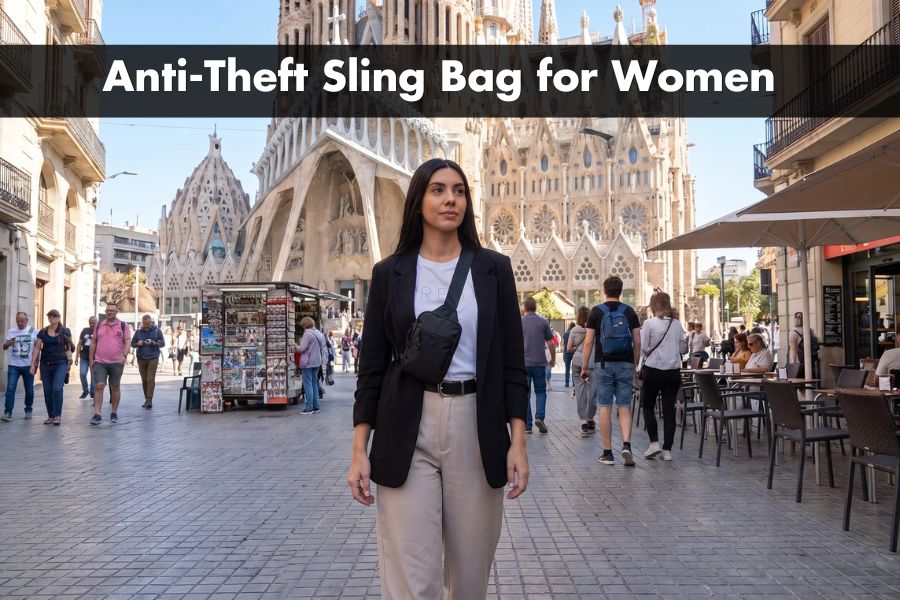
Barcelona, Rome, Prague, Paris — cities where pickpocketing is a real concern. A sling worn in front of the body is the most defensible carry position in a crowd. Pair it with RFID-blocking pockets for complete protection.
Long travel days (airports, trains)
Diagonal strap distributes weight across your torso rather than pulling on one shoulder. For 8+ hours of transit, that difference is significant.
Carrying a tablet or e-reader
Most travel sling bags include a padded device sleeve — a feature crossbody bags rarely offer. If you're reading on a flight or working from a café, a sling handles that load cleanly.
Budget airline travel
A structured sling bag almost always qualifies as a personal item on carriers like Ryanair, Spirit, and Frontier. The rigid shape slides under the seat without compression. See our Ryanair personal item size guide for exact dimensions.
Active travel (hiking, biking, walking tours)
Sling bags sit tighter to the body than crossbody bags and move less when you're active. The chest-carry position keeps the bag from swinging on trails or cobblestone streets.
Verdict: For most travel scenarios — especially international city travel — a travel sling bag is the more practical, more secure, and more comfortable choice.
When a Crossbody Bag Is the Better Choice
A crossbody bag earns its spot when style and quick access take priority over capacity and security features.
Evening outings and dinners
A slim crossbody complements dressier outfits better than a structured sling. If you're doing nicer restaurants or a show, a crossbody carries essentials (phone, cards, key) without looking like you packed for a day hike.
Low-key beach or resort travel
In relaxed destinations with lower theft risk, a crossbody's faster side access is convenient for grabbing sunscreen, a snack, or your hotel key without rotating the bag to your chest each time.
Carrying very minimal essentials
If all you need is a phone, lip balm, and a card — a slim crossbody is proportional to the task. A sling bag's structure becomes unnecessary bulk for a truly light carry.
Pairing with a larger bag
If your primary bag is a carry-on backpack, a small crossbody makes a great secondary day bag — light, packable, and easy to toss in the main bag when not in use.
The honest summary: crossbody bags shine in lower-risk, lower-demand scenarios. When your trip involves crowds, long walking days, or high-theft cities, the sling's advantages become too significant to ignore.
Can One Bag Do Both Jobs?
Yes — and this is where modern travel sling bags have quietly closed the gap. The best travel slings are designed with a strap long enough to wear at hip level (crossbody style) and short enough to pull tight across the chest (sling style). You get both carry positions in one bag, which means you're not choosing between security and style — you're adjusting based on where you are.
In a busy metro station? Shorten the strap, pull it to your chest. At a rooftop bar in Lisbon? Let it drop to the hip, open it from the side. Same bag, two positions, right choice for the moment.
This versatility is one reason a quality travel sling bag is often the single most useful thing to pack. It's lighter than a travel backpack, more functional than a crossbody, and the right size for a full day out without checking a bag.
If you want one bag that handles city days, airports, and evenings — choose a travel sling bag with an adjustable strap. It covers the sling position for crowded spots, the crossbody position for casual carries, and everything in between. You'll replace two bags with one, and carry less without giving anything up.
For guidance on what else to look for before you buy, our guide to anti-theft bags for women traveling to Europe covers security features in depth — including what separates genuinely protective construction from bags that just use the "anti-theft" label.
Frequently Asked Questions
What is the difference between a sling bag and a crossbody bag?
The key difference is how the strap attaches and where the bag sits on your body. A sling bag has a single diagonal strap that anchors at both the top and bottom of the bag, pulling it tight across your chest or back — it can swing to your front for access without removing it. A crossbody bag has a longer strap that attaches at both ends of the bag's top edge and lets the bag hang at your hip or waist. Sling bags tend to be more structured with more capacity; crossbody bags tend to be flatter and more style-forward. Many modern travel bags blur the line by supporting both carry positions with an adjustable strap.
Is a sling bag or crossbody better for Europe travel?
A sling bag is generally the better choice for European city travel, especially in high-theft destinations like Barcelona, Rome, Paris, and Prague. The chest-carry position keeps the bag in your line of sight at all times — the single most effective theft deterrent in a crowded space. Sling bags also tend to have more anti-theft features built into their design: hidden zippers, RFID-blocking pockets, slash-resistant materials. That said, a crossbody is perfectly fine for low-risk destinations or evening outings where you're carrying minimal essentials and prioritizing style over security.
Can a sling bag be used as a personal item on a plane?
Yes — most sling bags qualify as a personal item on virtually every major airline. Personal item size limits typically run around 18×14×8 inches (varies by carrier), and a standard 6–12L travel sling bag fits comfortably within those dimensions. The structured shape also slides cleanly under the seat in front of you, which soft crossbody bags sometimes struggle to do. If you're flying a strict budget carrier like Spirit, Frontier, or Ryanair, measure your specific bag before flying — those airlines enforce their personal item limits more aggressively than legacy carriers.
How much can a sling bag hold for a day trip?
A 7–10L travel sling bag handles a full day trip comfortably. That typically includes: a phone, passport or wallet, a light layer or scarf, a 500ml water bottle, earbuds, charger or power bank, sunscreen, and a snack. Some structured sling bags in the 10–15L range can also fit a tablet or e-reader in a padded sleeve. If you need to carry a laptop, a small backpack is a better fit — sling bags generally max out at 10" tablets before the shape becomes awkward.
Should I get a sling bag or backpack for travel?
It depends on trip length and how much you're carrying. For day trips, city exploring, and light carry — a sling bag wins: it's faster to access, more secure in crowds, and far less tiring than a backpack. For multi-day trips, overnight stays, or any time you're carrying clothes and toiletries — a carry-on backpack is the right tool. The most common and comfortable travel setup is both: a backpack for transit and hotel check-in days, a sling for everything in between. Our guide to the best carry-on backpacks for travel covers how to choose the right size and features for your specific trip.
Final Thoughts
The sling bag vs crossbody debate mostly comes down to one question: are you prioritizing security and comfort, or style and quick access? For the vast majority of travel scenarios — crowded cities, long transit days, high-theft destinations — a sling bag outperforms a crossbody on every practical metric.
But if you're going to a relaxed resort, doing a night out, or carrying truly minimal essentials in a low-risk destination, a crossbody earns its place. The best travel setup for many people is having both: a structured sling bag as the workhorse and a small crossbody tucked inside for evenings.
If you only want one bag for your trip, choose a travel sling bag with an adjustable strap. Worn tight and diagonal across the chest in crowded spaces, dropped to the hip at dinner — it's the most versatile single piece of travel gear you can carry. Built right, with hidden zippers and RFID-blocking pockets, it's also the most secure.
One Bag. Every Situation.
Arca's travel sling bags are built for exactly this — anti-theft construction, RFID-blocking pockets, adjustable straps that go from chest carry to crossbody in seconds. Backed by a 1-year warranty and designed to go anywhere you do.
Shop Travel Sling Bags →Arca Team
The Arca Official Team is a group of avid travelers and gear enthusiasts based between Vancouver, Canada and Buenos Aires, Argentina. Founded by two entrepreneurs who couldn't find affordable, quality travel gear, Arca Official has helped thousands of travelers pack smarter. Every article is researched and written by team members who test the gear themselves.